
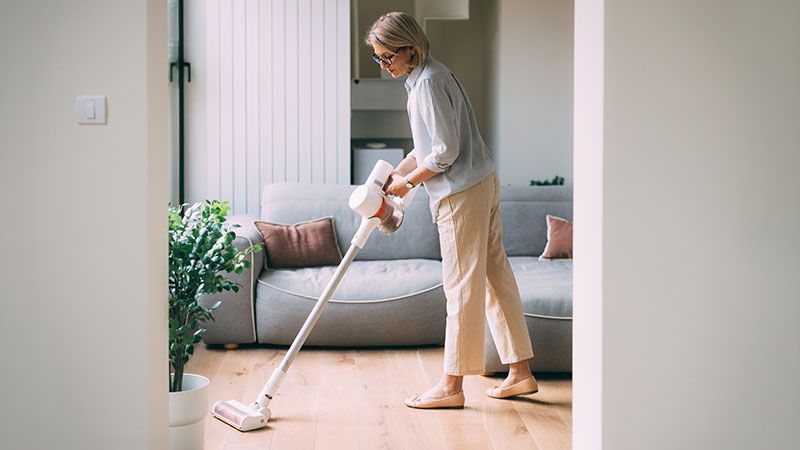
If you moved to Scottsdale from almost anywhere else, you probably arrived with a cleaning routine that worked fine back home. Vacuum on Saturday, wipe the baseboards once a month, done. Then you lived through your first monsoon season, ran a finger across a windowsill in August, and realized the desert plays by different rules.
Here’s the honest answer to the question we get asked at the counter more than any other: in the Valley, the “once a week” advice you grew up with is a floor, not a target. Most Scottsdale homes need more, and the reason has less to do with tidiness than with what our dust is actually made of and where it ends up.
Why desert dust is a different problem
Scottsdale sits inside a federally designated PM10 nonattainment area — a roughly 3,000-square-mile stretch of Maricopa and Pinal counties that does not meet national air quality standards for particles smaller than ten microns (ADOT dust control guide). Maricopa County’s own dust rules name Scottsdale explicitly among the cities inside that boundary (Maricopa County Rule 310.01), and the county has been in nonattainment status for PM10 for decades (EPA Green Book).
That designation is not trivia. It means the outdoor air around your home carries a heavier load of fine mineral particles than the air in Seattle or Chicago, and a portion of that load migrates indoors every time a door opens, an HVAC system cycles, or a breeze crosses a patio.
Then there’s monsoon season, which the National Weather Service marks from June 15 through September 30, with the most intense storms typically in July and August (Arizona State University). Those outflow winds can drive walls of dust across the Valley in minutes (The Arizona Republic). A single storm can leave a measurable film on floors in a house that was spotless that morning.
Add the ordinary indoor contributors — dust mite fragments and droppings, which the American Lung Association identifies as one of the major indoor allergy and asthma triggers (American Lung Association) — plus pet dander, and you have a mix that is both gritty and biologically active.
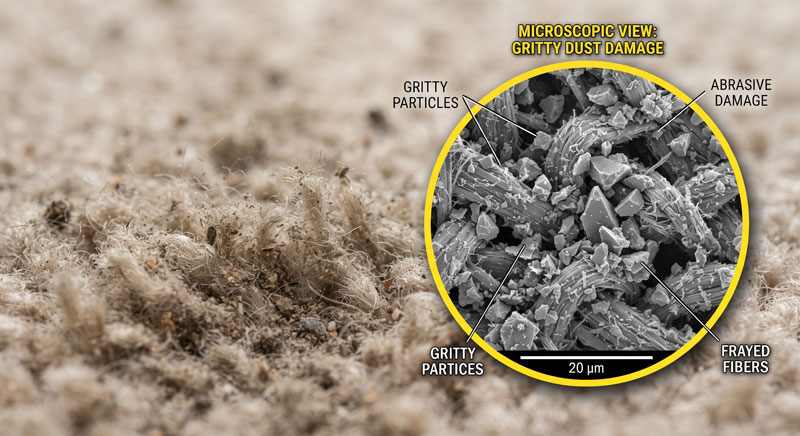
Grit is the part people underestimate
Desert dust is abrasive. It is essentially pulverized rock and soil, and once it works into carpet fiber it behaves like fine sandpaper every time someone walks across the room. Homeowners often think of vacuuming as a cosmetic chore. In Scottsdale it’s closer to preventive maintenance for your flooring.
The same grit is hard on the machine doing the cleaning. Fine mineral particles clog filters faster, load bags sooner, and wear bearings and brush rolls more aggressively than the household lint a vacuum was tested on. This is a big part of why we see so many mid-priced machines come through the shop with the same story: it worked great for two years, then lost suction and never got it back.
A realistic vacuuming schedule for Valley homes
There is no official government schedule to point to. The EPA explicitly declines to recommend a carpet cleaning frequency and defers to manufacturer and industry guidance (EPA), while noting more broadly that frequent cleaning and ventilation are effective ways to reduce indoor dust and particulates (EPA indoor particulate matter guidance).
So the schedule below is ours — built from years of seeing which Scottsdale homes stay clean and which vacuums die young.
Entryways, hallways, and the first ten feet inside any exterior door: every day or every other day. This is where tracked-in grit lands. Catch it here and you keep it out of the rest of the house.
Main living areas with hard floors: two to three times a week. Fine dust settles visibly on tile and luxury vinyl within a day or two. Use a vacuum with a hard-floor setting rather than a broom — sweeping lifts the finest particles back into the air you breathe.
Carpeted living areas: two to three times a week. More than the national once-a-week default, because our dust reaches carpet backing faster and does more damage there.
Bedrooms: twice a week. You spend a third of your life in that room, and it is where dust mite allergens concentrate.
Upholstery and pet furniture: weekly. Cushions act as reservoirs. Vacuum them and you stop re-releasing the same dust every time someone sits down.
Area rugs: weekly on top, and lift them monthly to vacuum underneath. The floor beneath a rug collects more grit than most people expect.
Mattresses: monthly, with an upholstery tool.
During monsoon season, add a pass after any significant dust event. One extra ten-minute pass through entries and main floors after a haboob prevents days of tracking that dust deeper.
Snowbirds and part-time residents: run a full pass through the house when you arrive and again before you leave, and consider having someone vacuum entryways midway through a long absence. Dust settles just as steadily in an empty house.
Homes with pets, allergy sufferers, small children, or a nearby construction site or vacant lot should treat the upper end of each range as the baseline.
Frequency only works if the vacuum holds what it picks up
This is where a lot of well-intentioned effort goes to waste. Vacuuming three times a week with a machine that leaks fine dust back into the room is a lot of work for a modest result. What matters in this environment:
Sealed filtration with true HEPA media. A HEPA filter that sits inside a body with gaps around the seams lets fine particles escape through the housing. Sealed construction is what keeps ten-micron and smaller particles contained.
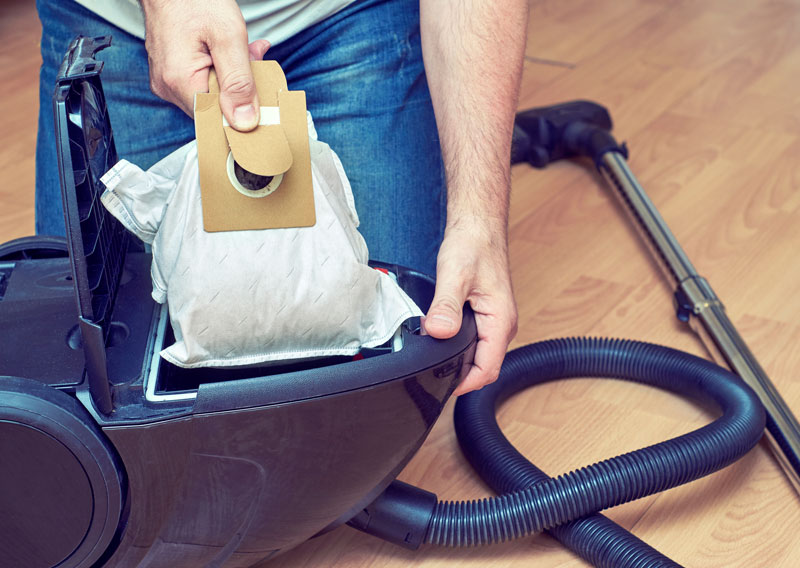
A bagged system. Emptying a bagless canister releases a cloud of exactly the dust you just spent time collecting — and in the Valley, that cloud is heavy on abrasive mineral particles. A sealed bag comes out and goes in the trash.
Filters you can actually get and change on schedule. Desert dust shortens filter life. A machine with easy, available replacement filters stays effective; a machine with obscure filters slowly turns into a noisemaker.
Genuine suction plus real agitation. Motorized brush rolls do the work of lifting embedded grit out of pile. Suction ratings on a box tell you very little on their own.
Serviceable, durable construction. In an abrasive-dust environment, a vacuum you can maintain and repair for fifteen years is far cheaper than three disposable machines. This is why we point most Scottsdale customers toward brands like SEBO, Miele, and Riccar rather than whatever is on the endcap this month.
Maintenance that matters here more than elsewhere
Change bags at two-thirds full, not when the machine stops working — airflow drops long before the bag looks packed. Check and clean filters on a set calendar rather than by feel. Cut hair and fiber off brush rolls monthly. And plan on a professional tune-up roughly once a year: motor brushes, seals, belts, and hose integrity are the things that quietly degrade in dusty conditions, and they’re all straightforward to address before they become a repair.
The short version
In the Desert Southwest, plan on vacuuming high-traffic areas every day or two, main living spaces and bedrooms two to three times a week, upholstery weekly, and add an extra pass after every monsoon dust event. Then make sure the machine you’re using seals, bags, and filters what it collects — and that it’s built to survive the grit it’s fighting.
If your vacuum has lost suction, smells hot, or has never had a filter change, bring it in. We’ll tell you honestly whether it’s worth servicing or whether you’d be better off with a machine designed for the way dust behaves out here.