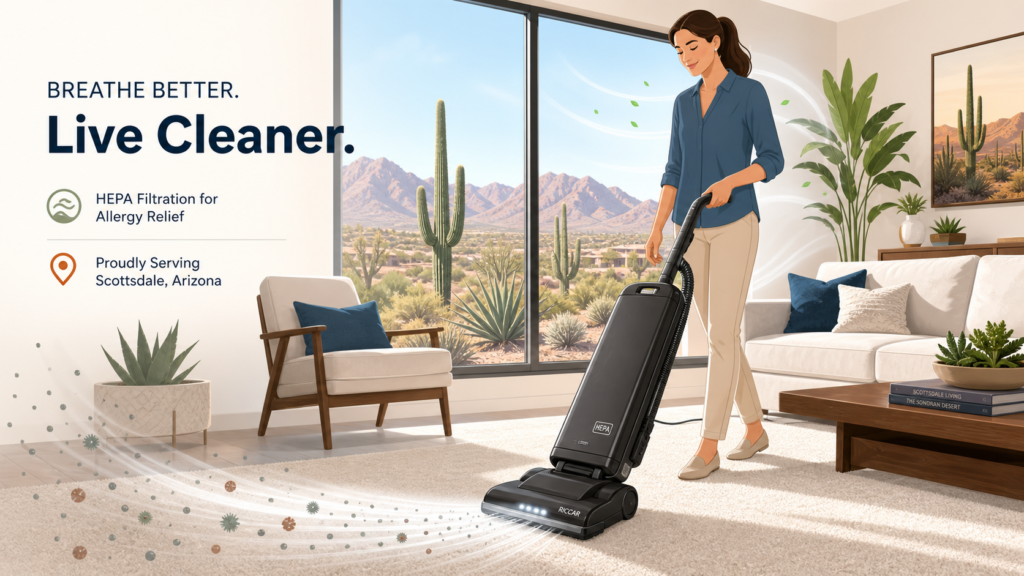
If you live in Scottsdale and deal with allergies, you may have asked yourself whether a HEPA filter is actually necessary or just another feature added to make a vacuum sound more advanced. It is a fair question. Not every household needs the same level of filtration, and not every vacuum with “allergy” language on the box performs the same way. Still, for many people in the Valley, especially those dealing with dust, pollen, pet dander, or asthma symptoms, a true HEPA filter can make a meaningful difference in how clean a home feels after vacuuming.
Scottsdale homes face a specific mix of indoor and outdoor irritants. The desert climate means dry air, fine dust, and frequent buildup on floors, furniture, and vents. Seasonal pollen can also find its way indoors through doors, windows, shoes, pets, and air movement. Once those particles settle into carpet, rugs, upholstery, and mattresses, they do not just stay there quietly. They are often stirred back into the air by walking, sitting, dusting, or using a vacuum with weak filtration. That is why the question is not only whether your vacuum picks debris up off the floor, but also whether it keeps tiny particles trapped once they are collected.
What a HEPA Filter Actually Is
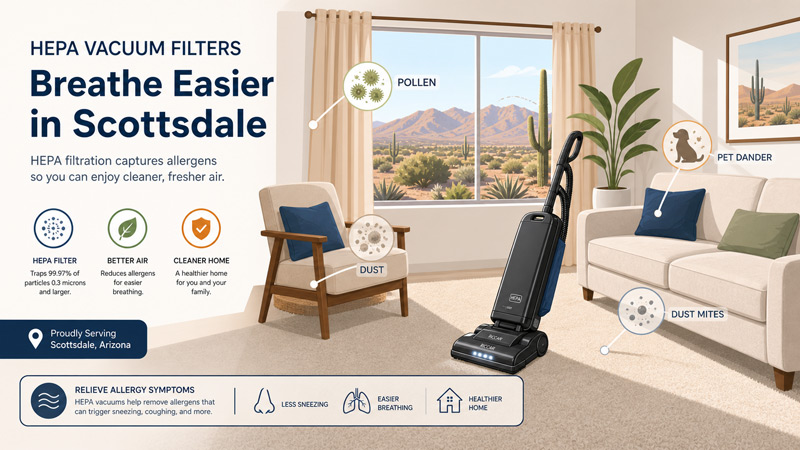
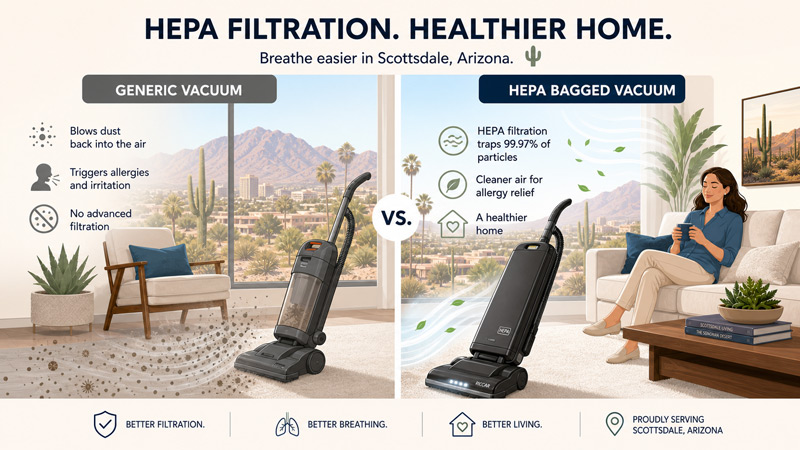
HEPA stands for High Efficiency Particulate Air. A true HEPA filter is built to capture at least 99.97 percent of particles down to 0.3 microns. That standard matters because many allergy-related particles are extremely small. Fine dust, pollen fragments, mold spores, and dust mite waste can all contribute to symptoms, and a filter that traps those particles instead of recirculating them can help reduce irritation during and after cleaning.
Many homeowners assume all filters are more or less the same, but that is not really true. Basic foam, cloth, or paper filters may catch visible dirt while allowing much finer particles to pass through the vacuum and back into the room. If that happens, your vacuum may leave the floor looking cleaner while still pushing allergens into the air you breathe. In practical terms, that means you finish vacuuming and still end up sneezing, rubbing your eyes, or feeling congestion shortly afterward.
Why Filtration Matters in Scottsdale Homes
The Scottsdale area creates the perfect conditions for fine dust to become part of daily life. Even homes that are well maintained can collect desert dust quickly, and that dust does not stay limited to hard surfaces. It works its way into carpet fibers, settles into area rugs, collects along baseboards, and clings to upholstered furniture. If you have pets, the problem grows because dander and hair combine with dust and outdoor particles brought in from outside.
For allergy sufferers, the goal is not simply to make floors look clean. The goal is to reduce what becomes airborne inside the home. A vacuum with a true HEPA filter helps because it traps particles inside the system before the air is exhausted back into the room. That can be especially important in bedrooms, family rooms, and other places where people spend long stretches of time. If your symptoms tend to get worse while cleaning or later in the evening after vacuuming, filtration may be one of the reasons.
True HEPA vs. HEPA-Style
One of the biggest sources of confusion is product labeling. You may see phrases like “HEPA-type,” “HEPA-style,” or “allergen filtration” on boxes, online listings, and replacement parts. Those terms are not automatically the same as a true HEPA filter. They often sound close enough to create confidence, but they may not meet the same tested standard.
That distinction matters because allergy relief depends on actual performance, not vague wording. A true HEPA filter is held to a measurable standard. A “HEPA-style” filter may help somewhat, but it may also leave more fine particles escaping through the exhaust. If allergies are a serious issue in your home, it is worth paying attention to exactly what the vacuum uses rather than assuming similar language means equal results.
A HEPA Filter Alone Is Not the Whole Story
It is important to understand that a HEPA filter works best as part of a sealed vacuum system. In other words, the machine should be designed so that the air passing through it stays contained and is directed through the filter instead of leaking through gaps, poorly fitted compartments, or low-quality housing. A vacuum can advertise a HEPA filter and still perform poorly if the rest of the machine allows dusty air to escape before it reaches that filter.
This is one reason specialty vacuum stores often emphasize overall build quality, not just a single feature on the spec sheet. Good suction, sealed construction, quality bags or bins, and proper maintenance all affect how much real-world benefit you get. For allergy sufferers, the vacuum should be viewed as a system rather than a checklist item.
Who Should Strongly Consider HEPA
p>For some households, HEPA filtration is more than a nice extra. It is a smart priority. If someone in your home has diagnosed allergies, asthma, sinus sensitivity, or breathing issues, a true HEPA vacuum is usually worth serious consideration. The same goes for homes with pets, lots of carpeting, fabric furniture, or frequent dust buildup.
You should also pay attention to your experience while cleaning. Do you sneeze when emptying the vacuum? Do your eyes itch after vacuuming? Does the room seem dusty again right away? Those signs do not always prove the filter is the problem, but they often suggest your current vacuum is not containing fine particles very effectively. In those cases, upgrading to a better filtration system can improve both comfort and cleaning results.
When HEPA May Be Less Essential
That does not mean every home absolutely must have HEPA filtration. If your house has mostly hard flooring, very little carpet, few soft surfaces, no pets, and no one with significant allergies, you may be able to do well with a quality vacuum that has solid filtration even if it is not true HEPA. Some homeowners are mainly focused on visible dirt pickup, convenience, or occasional use, and they may not notice enough difference to justify the upgrade.
Still, many people find that once they understand how much fine dust circulates in a desert environment, HEPA becomes easier to justify. Even when allergy symptoms are mild, better filtration can contribute to a cleaner-feeling home and fewer particles released back into living areas. So while it may not be mandatory for everyone, it often ends up being worthwhile for more people than they first expect.
Bagged vs. Bagless for Allergy Sufferers
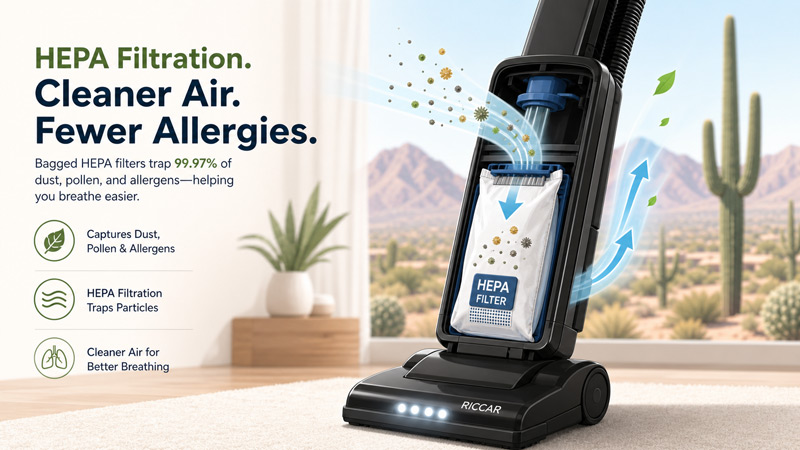
The HEPA conversation also connects to whether a vacuum is bagged or bagless. For allergy sufferers, bagged models often have an advantage because they generally keep debris more contained during disposal. When it is time to empty the machine, a sealed bag can usually be removed and discarded with less direct exposure to dust and dander. That can make a real difference if you are sensitive to what the vacuum has collected.
Bagless machines appeal to many homeowners because they avoid the ongoing cost of replacement bags, but they can create a dust cloud when emptied if you are not careful. Even if the vacuum itself uses a HEPA filter, the disposal process can still reintroduce allergens to the air. For people with stronger allergy symptoms, a bagged vacuum with a sealed system and true HEPA filtration is often the more comfortable choice.
Maintenance Still Matters
Even the best HEPA filter will not perform well forever without proper maintenance. Filters clog over time, bags fill up, brush rolls collect hair, and airflow drops when hoses or wands become obstructed. In a place like Scottsdale, where fine dust is part of the environment, that buildup can happen faster than many homeowners expect.
That is why routine service matters. If your vacuum has a replaceable HEPA filter, it should be changed according to the manufacturer’s guidance or sooner if your home deals with pets, heavy dust, or frequent use. If the machine is bagged, the bag should be replaced before it becomes packed full. If it is bagless, the bin and pre-filters should be cleaned carefully and consistently. A neglected vacuum can lose both suction and filtration performance, which defeats much of the reason for having HEPA in the first place.
Common Misunderstandings About HEPA
One common misunderstanding is that a HEPA filter solves every indoor air issue by itself. It does not. A HEPA vacuum helps reduce particles captured from floors and fabrics, but it is only one part of a bigger home-cleaning strategy. Bedding, upholstery, HVAC filters, entry mats, dusting habits, and even how often doors and windows are opened all affect indoor allergen levels.
Another misunderstanding is that HEPA filters are only for extreme allergy cases. In reality, even households with mild symptoms can benefit from improved filtration, especially in dusty climates. You do not have to wait until allergies become severe before choosing equipment that keeps more particles contained. Often, the people who benefit most are the ones who notice subtle but consistent irritation and want a cleaner home without stirring up more dust every time they vacuum.
So, Do You Really Need One?
If you live in Scottsdale and regularly deal with dust, pollen, pet dander, or allergy symptoms, the answer is often yes. A true HEPA filter is not just a marketing feature when it is paired with a well-designed vacuum and proper maintenance. It can help reduce the amount of fine material released back into your home during cleaning, which is exactly what many allergy sufferers need.
If your symptoms are minimal and your home has mostly hard floors with very little fabric, HEPA may be more of a preference than a requirement. But for many local households, especially those with pets, carpets, or respiratory sensitivity, it is a practical upgrade that supports a healthier and more comfortable indoor environment.
The most important thing is choosing the right vacuum for your actual home, not just buying based on a label. If you are unsure whether HEPA is worth it for your situation, comparing floor types, allergy concerns, pets, and maintenance habits can make the answer much clearer. In many cases, the right filtration setup turns vacuuming from something that triggers symptoms into something that genuinely helps control them.