
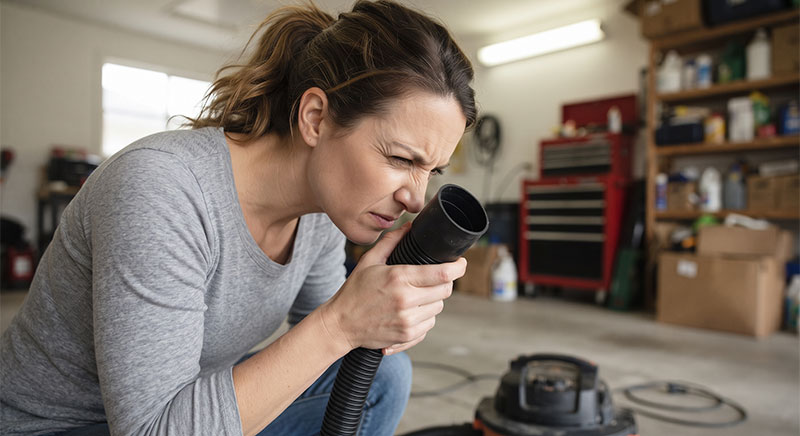
“I put my hand over the hose, and it seems to be suctioning just fine. So why is there still sand in the carpet?”
We hear some version of that at our counter every week. And the customer is usually right: the suction really is fine. The problem is that suction and floor pickup are not the same thing, and a vacuum can have plenty of one while quietly failing at the other.
This guide explains the difference, walks you through the checks you can safely do at home, gives you specific things to look for on SEBO, Miele, Riccar, Shark, and Dyson machines, and tells you exactly when it is time to stop troubleshooting and bring it to us.
Suction and Pickup Are Two Different Jobs
Think of your vacuum as a two-person team.
The motor creates suction. It moves air through the hose, the bag or bin, and the filters. That airflow carries dirt away once the dirt is loose.
The floor head creates pickup. On carpet, the brushroll (also called a brush bar or agitator) spins, combs into the pile, and knocks loose the sand, grit, hair, and dust that are wedged down between the fibers. Only then can the airflow carry it off.
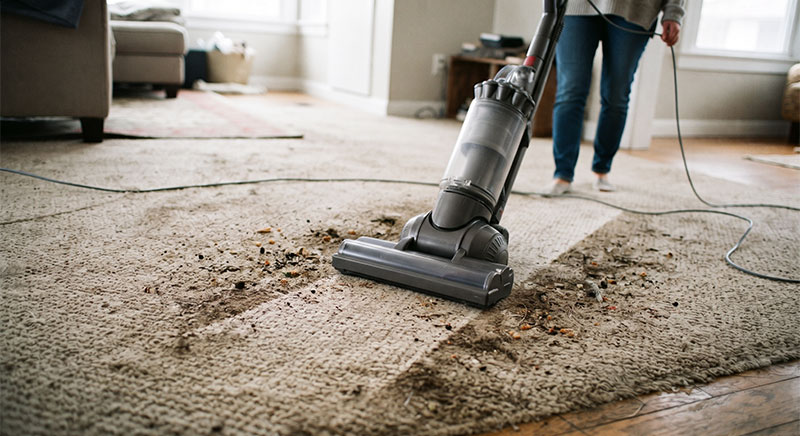
If the motor is strong but the brushroll is not doing its job, you get exactly what you are seeing: great suction at the hose, and dirt left behind on the floor. This is especially noticeable here in the Valley, where fine desert dust and sand settle deep into carpet and need real agitation to come out.
Floor pickup depends on four things working together:
- Agitation: the brushroll spinning at full speed with bristles that still reach the carpet.
- Height: the floor head sitting at the right distance from the carpet pile.
- Seal: air being pulled through the floor head opening, not leaking in somewhere else.
- Airflow at the head: suction actually reaching the floor head, not just the hose.
When one of those fails, pickup drops even though the motor sounds and feels normal.
A Quick Test: Is It Suction or Pickup?
Before you take anything apart, try this two-minute test.
- Check suction at the hose. With the vacuum running, use the hose or wand. If it pulls strongly, your motor, bag or bin, and filters are probably doing their part.
- Check suction at the floor head. Now put the floor head back on and hold your hand near the opening underneath (keep fingers well away from the brushroll). If suction is strong at the hose but weak at the floor head, you likely have a clog in the floor head, the neck, or the wand.
- Watch the brushroll. Carefully tip the vacuum back while it is running on carpet mode and look at the brushroll. Is it spinning? Is it spinning at full speed, or slowly and unevenly?
- Do a sprinkle test. Sprinkle a little baking soda or rice on a small carpet area and make a few slow passes. If it stays behind on carpet but picks up fine on hard floor, the issue is almost always agitation or height.
That last test tells you a lot. A vacuum that cleans hard floors well but struggles on carpet is usually a brushroll, belt, or height problem, not a motor problem.
The Most Common Reasons for Poor Pickup
The brushroll is not spinning, or not spinning fast enough
This is the number one cause we see. Look for:
- A broken or stretched belt. Many belt-driven uprights will run, sound fine, and pull air while the brushroll barely turns. A stretched belt can still turn the brush when you watch it in the air but slip once it touches carpet.
- Hair and thread wrapped around the brushroll. Long hair winds tight around the ends and into the bearings, slowing the brush down. Cut it away with scissors or a seam ripper, working along the bristle channel.
- Seized or worn bearings. If the brushroll is hard to turn by hand (with the vacuum unplugged), the bearings may be worn. This is a common repair.
- Carpet mode not selected. Many vacuums turn the brush off for hard floors. It sounds obvious, but we see it often, especially after someone else in the house used the vacuum.
The bristles are worn down
Brushroll bristles wear like a toothbrush. When they are short and rounded, they skim over the carpet instead of reaching into it. The vacuum still runs and still has suction, but carpet pickup drops steadily over months, so it is easy to miss. Hold a ruler or a flat card across the bristles. If they barely reach past the edge of the brushroll housing, the brush is likely worn.
The height setting is wrong
If the floor head is set too high, the brush barely touches the carpet. Too low, and the head chokes airflow and can be hard to push. Either way, pickup suffers. On machines with manual height dials, try one setting lower and repeat the sprinkle test.
There is a clog in the floor head or neck
A partial clog right at the floor head is the classic “strong at the hose, weak at the floor” problem. Check the opening behind the brushroll, the neck or swivel joint, and the connection to the wand. Look for socks, a wad of hair, pet toys, or packed-in sand.
An air leak is breaking the seal
Air takes the easiest path. A cracked hose, a loose wand connection, a missing hose cuff, an open suction-control slider, or a bag door that is not latched all let air in somewhere other than the floor head. The motor works just as hard, but less of that suction reaches the carpet.
The bag or filters are fuller than they look
Bags lose airflow well before they look full, especially with fine Arizona dust, which coats the inside walls of the bag and clogs the pores. If your vacuum has a bag-full indicator, take it seriously. If it does not, try a fresh bag before assuming something is broken.
Model-Specific Checks
Many premium and popular vacuums give you clear signals about what is wrong. Here is what to look for on the brands we see most often.
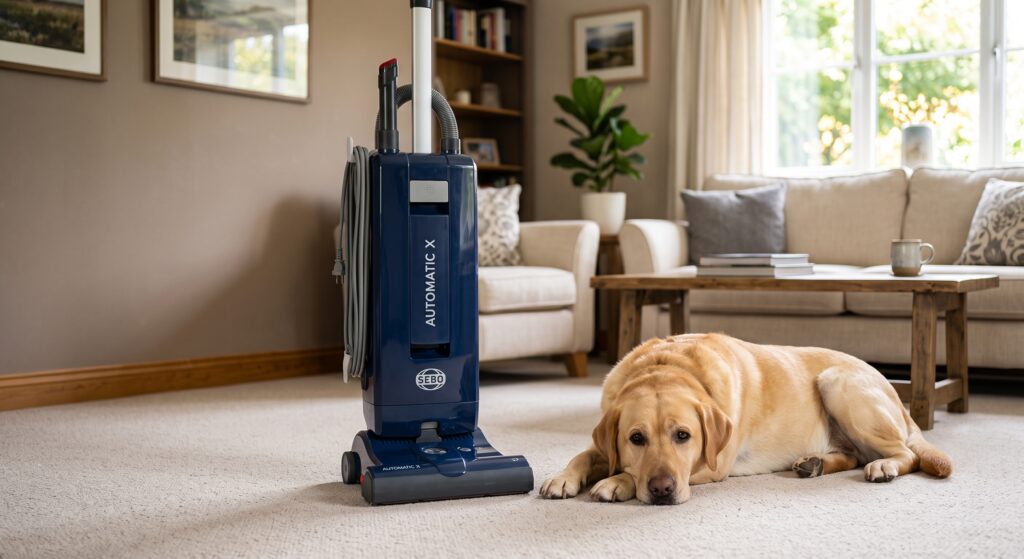
SEBO Automatic X-Series (X4, X7, X8)
SEBO’s Automatic uprights adjust brush height for you and use the red “check brush” light to tell you what is going on. According to the SEBO X7/X8 instruction manual:
- Red brush light flashing quickly, motor off: the brushroll is jammed. Turn off, unplug, and clear the obstruction.
- Red brush light on continuously: the brushroll is worn and should be replaced. The machine keeps running, which is why people miss it, but carpet cleaning is reduced.
- Red brush light flashing slowly in the upright, locked position: the brush is still touching the carpet while parked. Do not leave the machine running in one spot.
- Bag/clog light on continuously: change the bag or clear a clog.
SEBO notes that the worn-brush warning comes on when the bristles are worn to the point that agitation is less effective. If your X7 has suction but leaves dirt behind and that red light stays on, a new brushroll is very likely the fix.
SEBO FELIX and ET-1 Power Heads
The FELIX uses a four-position manual height dial. The SEBO FELIX manual explains that the red brush light comes on if the height setting is too high; dial down until the light goes out. If the red light stays on even at setting 1, the brushroll may be worn. This is one of the clearest pickup diagnostics on any vacuum we sell.
Miele Canisters with an Electrobrush (SEB 228, SEB 234, SEB 236)
Miele’s Electrobrush has a multi-function light on the head. Per Miele’s SEB 236 instructions:
- Yellow light: the Electrobrush is on and working.
- Red light: the roller is blocked. Unplug, clear the blockage, then press the indicator light to reset the blockage sensor.
- Brush stops but light is still yellow: the overheating protection has tripped, often from a blockage or clogged filters. Check the airways and filters and let the head cool for about ten minutes.
If your Miele canister has great suction at the hose but leaves dirt on carpet, make sure the Electrobrush is actually switched on and its light is yellow. Also check the suction setting on the canister; a low power setting is fine for drapes but not for carpet.
Miele owners with an air-driven turbo brush: these heads use airflow to spin the brush. If the bag is full or there is an air leak, the brush slows down even though the canister still sounds strong. A fresh bag and a sealed connection often bring it right back.
Riccar R25 Series
The R25 has a brushroll mode button with three settings. The Riccar R25 manual explains that a solid green light means carpet “High,” a flashing green light means “Low” for delicate rugs, and no light means the brushroll is off for bare floors. If carpet pickup is poor, first confirm you are on High, not Low.
On the R25P and R25D, the headlight flashes red if the brushroll jams. If the brushroll is clear and the light still flashes, Riccar says there is likely an issue with the brushroll motor and the vacuum should go to an authorized dealer for service. On the R25S, a belt protection breaker can shut the brush off; the reset button is under the top of the nozzle. Riccar also covers the R25 belt with a lifetime warranty, so if your belt breaks, bring it in.
Shark Uprights (Navigator, Rotator, Stratos, Vertex, APEX)
Many Shark uprights have a brushroll indicator. According to Shark’s APEX FAQ:
- Solid green: brushroll is working.
- Solid red: jam in the brushroll area.
- Flashing red: the motorized floor nozzle is overheating; turn off and let it cool.
- No light: the brushroll is off because the vacuum is in hard floor mode.
On DuoClean models, check both the main brushroll and the soft front roller for wrapped hair. Shark’s lift-away design also has several hose and wand joints, so check each connection for clogs. Shark’s maintenance guidance recommends letting an overheated nozzle cool for at least 60 minutes before restarting.
Dyson Cordless and Upright Models
Dyson brush bars are designed to stop to protect the machine and the carpet. Dyson’s support guide notes that on certain deep-pile carpets or rugs, the brush bar may stop spinning, and some floor tools have a suction control slider that may help. To narrow it down, Dyson suggests connecting the floor tool directly to the bin without the wand: if the brush spins that way, the wand is likely damaged; if it does not spin on any tool, the problem is elsewhere in the machine.
On older Dyson uprights, the Dyson DC40 manual explains that the brush bar does not spin while the machine is upright, and that it stops automatically if obstructed. Make sure the machine is fully reclined and the brush bar button is on.

When to Stop Troubleshooting and Bring It In
Home checks are worth doing, and many of these problems are solved with a fresh bag, a clean filter, or a pair of scissors and five minutes on the brushroll. But here is our honest line. Bring it to us when:
- The brushroll does not spin, or spins slowly, after you have cleared hair and confirmed carpet mode. This usually means a belt, bearing, brushroll motor, or electrical issue inside the floor head.
- A warning light stays on after you have cleared the jam and reset it. SEBO, Miele, Riccar, and Shark lights are telling you something specific. If the light will not clear, the cause is internal.
- The worn-brush indicator is on. We can confirm whether the brushroll needs replacing and get the correct part for your model.
- You smell burning rubber or hot plastic. That is often a belt slipping on a stuck brushroll, or a motor working too hard. Stop using the vacuum.
- The brushroll will not turn by hand when the machine is unplugged. Worn or seized bearings need proper replacement.
- Suction is strong at the hose but weak at the floor head, and you cannot find the clog. Some clogs sit inside the neck or swivel and need disassembly.
- The floor head is cracked, a wheel is broken, or the head will not sit flat. If the head cannot seal against the floor, pickup will not come back.
- The vacuum shuts itself off repeatedly. Thermal protection is doing its job, but something is causing it to overheat.
- You have tried everything above and the sprinkle test still fails. At that point, a bench diagnosis will save you time and frustration.
As a general rule: if fixing it would require opening a sealed housing, removing screws from the motor area, or working with wiring, it is time for a technician.
What We Check on the Bench
When you bring in a vacuum that has suction but poor pickup, we test it the way it is actually used: on carpet. We check brushroll speed under load, belt condition and tension, bearing wear, bristle length, height settings, every airflow connection from the floor head to the bag, bag and filter condition, and the warning sensors on machines that have them. Then we tell you plainly what we found and what it will take to fix it.
Most of the time, the answer is a belt, a brushroll, bearings, or a hidden clog. Those are among the most affordable and satisfying repairs we do, because the vacuum goes home cleaning like it did when it was new.
Get Your Vacuum Cleaning Carpet Again
If your vacuum still has suction but your carpets are not getting clean, bring it by Scottsdale Vacuums. We are an authorized dealer for SEBO, Miele, and Riccar, and we service Dyson, Shark, Kirby, Oreck, Bissell, Hoover, Rainbow, Electrolux, and many other brands when parts are available.
Bring the floor head, hose, and wand along with the vacuum, and tell us what you have already tried. It helps us get to the answer faster.